How to Fit Hockey Gloves the Right Way
A hockey glove that looks right on the shelf can feel completely wrong once a stick is in your hands. That is usually where fit issues show up - not when the glove is lying flat, but when you close your grip, handle a pass, or try to get a shot off quickly. If you are wondering how to fit hockey gloves, the goal is simple: enough room for comfort and mobility, with enough structure to keep your hands protected.
How to fit hockey gloves for comfort and control
The right hockey glove should feel secure without feeling restrictive. Your fingers should reach close to the end of the finger stalls, but they should not be jammed hard into the tips. In most cases, a small amount of space at the end is ideal because it gives you room to flex your hand naturally while still keeping the protective breaks lined up where they are supposed to be.
The back of the glove matters just as much. When you close your hand around the stick, the glove should move with you instead of fighting your grip. A glove that is too tight can make stickhandling feel stiff and can create pressure points across the knuckles and backhand. A glove that is too loose can shift around, dulling your feel on the stick and leaving gaps in protection.
At the cuff, you want free wrist movement without exposing too much of the lower forearm. Players often focus on finger length first, which makes sense, but the cuff opening and wrist mobility can make a major difference once you are skating, shooting, and receiving contact.
Start with hockey glove sizing
Hockey gloves are generally sized in inches, commonly from youth sizes up through senior sizes. That number refers to the overall glove length, not your exact hand measurement. As a starting point, sizing is often estimated by measuring from the base of the palm to the tip of the middle finger, then relating that to the glove size chart from the manufacturer.
That said, size charts are only a starting point. Brands fit differently, and even gloves in the same size can feel noticeably different depending on the line. Some models have a roomier traditional fit, while others are more tapered through the fingers and backhand. A player who wears a 13-inch glove in one line may prefer a 14-inch glove in another if the finger stalls run short or the backhand sits lower.
For growing players, parents are often tempted to size up for an extra season. A little room is fine, but too much extra space usually creates more problems than savings. Oversized gloves can reduce control, make it harder for younger players to grip properly, and allow the protective padding to sit in the wrong place.
What a proper fit should feel like
A properly fitted glove should feel natural as soon as you wrap your hand around a stick. The fingers should sit comfortably in the stalls with just a bit of room at the end. Your palm should rest flat without bunching, and the glove should not pinch along the sides of the hand.
When you open and close your hand, the glove should flex with very little effort. If it takes work to fully grip the stick, the glove may be too tight through the fingers, too narrow in the backhand, or simply too stiff for your preference. New gloves can need a short break-in period, but they should not feel like a struggle.
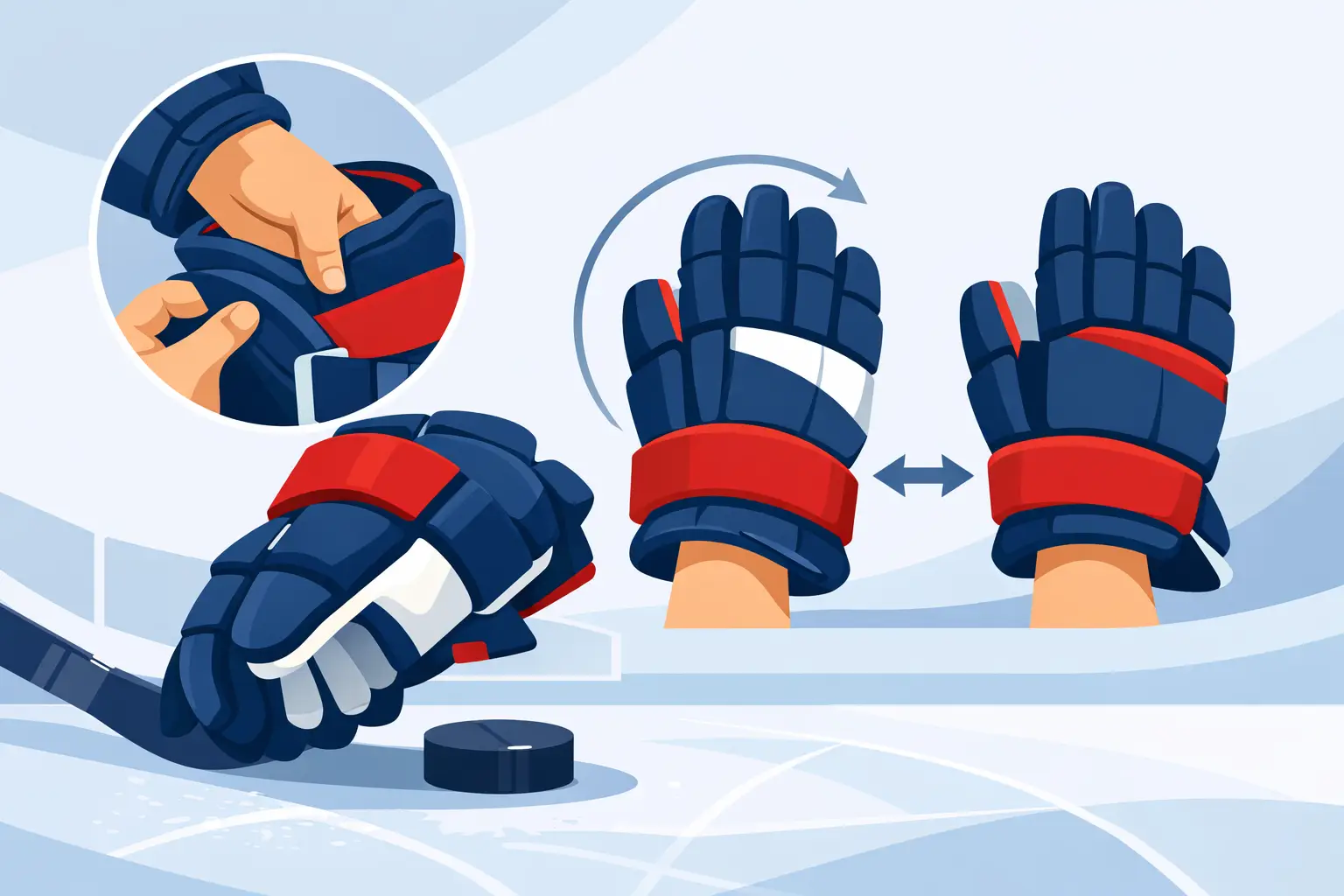
Pay attention to where the cuff sits when your top hand and bottom hand are both on the stick. You should be able to rotate your wrists freely for passing, shooting, and puckhandling. If the cuff jams into your wrist every time you move, that fit is going to get frustrating quickly.
Signs your hockey gloves are too small
Gloves that are too small usually tell on themselves fast. Your fingertips may press firmly into the ends of the stalls, especially when gripping the stick. The glove can feel tight across the knuckles or backhand, and the cuff may ride too high, exposing part of the wrist or lower forearm.
Players sometimes mistake a snug performance fit for a good fit, but there is a line. If you lose mobility, feel hand fatigue early, or notice rubbing at the fingertips, you have probably crossed it. Too-small gloves can also wear out faster in high-stress areas because the materials are under constant tension.
For younger players, small gloves can be harder to spot because they may not explain the discomfort clearly. If they are pulling the gloves off between drills, shaking out their hands, or avoiding a full grip on the stick, the size deserves a second look.
Signs your hockey gloves are too big
Oversized gloves usually feel roomy at first, which can seem comfortable in the store. On the ice, that extra space often becomes a problem. The fingers may sit too far back from the ends of the stalls, creating a delayed feel on the stick. The glove may twist slightly when handling the puck or shift when absorbing contact.
Large gloves can also leave protection out of alignment. If your knuckles are not sitting under the intended padding zones, impact protection is not working the way it should. The same goes for the cuff and wrist area. Too much length can interfere with movement, while too much volume can make the glove feel unstable.
This is one of the most common fit mistakes for youth players. Buying into extra growth room sounds practical, but if the glove is loose enough to affect grip and control, it is not helping the player.
Fit changes by player preference
There is no single perfect glove shape for every player. Some like a more traditional fit with extra room through the fingers and backhand. Others want a tapered fit that feels closer to the hand for a more responsive grip. Neither is automatically better. It depends on what feels natural and what kind of hand mobility the player prefers.
Position can influence this too, but not always in the way people assume. A defenseman might want maximum protection and choose a fuller fit, while another defenseman may still prefer a closer wrap for better stick feel. A forward may prioritize mobility, but some still like more volume in the cuff and backhand. The better question is not what your position should wear, but what lets you protect your hands without losing confidence with the puck.
Palm preference also matters. Some players want a soft palm for better stick feel right away. Others are willing to trade a slightly stiffer feel for durability. That is less about size and more about model choice, but it affects how the glove feels during fitting.
How to fit hockey gloves for youth players
For youth players, the best fit is usually the one that allows a clean, confident grip without excess bulk. Kids often do better in gloves that feel light, flexible, and easy to close. If the glove is too stiff or too large, they may struggle to control the stick properly.
Parents should check three things first: finger length, ease of grip, and wrist movement. If the fingers are not close to the ends, the glove is likely too big. If the child cannot close the glove comfortably around the stick, the glove may be too small, too stiff, or simply the wrong fit profile. If the cuff blocks wrist movement, shooting and passing mechanics can suffer.
It is also worth remembering that younger players may not separate comfort from performance very well. They may say a glove feels fine because it is soft or because they like the look. A proper fit check is still necessary.
The best way to try gloves on
If possible, fit hockey gloves with the rest of the upper-body gear in mind, especially elbow pads. The space between the glove cuff and elbow pad should work together without creating a major gap or causing the pieces to interfere with each other.
Always test gloves with a stick in hand. Open and close the hand several times. Take a shooting grip. Move the top hand through a puckhandling motion. These simple checks reveal much more than just putting the glove on and wiggling your fingers.
If you are shopping in person, this is where experienced pro shop guidance makes a difference. A specialist can spot poor finger depth, cuff restriction, or excess volume quickly. At Majer Hockey, that hands-on fitting approach is part of what helps players and parents avoid the common mistake of choosing by size tag alone.
For online shoppers, checking the manufacturer fit profile and comparing it to your current gloves is the next best step. If your current pair feels tight in the fingers but fine in overall length, you may need a different glove family rather than simply a bigger size.
A good hockey glove should disappear once play starts. If you notice it because your hands feel cramped, your grip feels sloppy, or your wrists cannot move freely, the fit is off. Get the size right, pay attention to the shape, and trust what the glove feels like with a stick in your hands. That is usually where the right choice becomes obvious.


 -
-