When Should Hockey Skates Be Replaced?
A skate rarely fails all at once. More often, the change shows up in small ways first - less support in tight turns, new lace bite, a boot that feels soft by the third period, or a child who suddenly says their toes hurt. If you are asking when should hockey skates be replaced, the real answer is not based on age alone. It comes down to fit, structural support, blade condition, and how the skate is performing for the player now.
For some skates, replacement is driven by growth. For others, it is driven by breakdown. A recreational adult may get several seasons from a pair that a competitive player would wear out much faster. That is why it helps to look at the skate as a piece of performance equipment, not just footwear.
When should hockey skates be replaced for fit?
Fit is the first place to look, especially for youth players. A skate that is too small is usually obvious - toe pressure, numbness, heel lift caused by compensating, or pain that starts early in a session. A skate that is too big can be harder to catch, but it is just as problematic. Extra space in the boot reduces control, creates movement inside the skate, and can lead to blisters or unstable edges.
For growing kids, one off-season can be enough to change everything. If a player has gone up a shoe size, developed foot pain, or started unlacing skates between shifts just for relief, the fit needs to be checked. Parents sometimes try to squeeze one more season out of a pair, which is understandable, but poor fit affects skating mechanics and comfort long before a skate looks worn out.
Adults usually replace for fit less often, but foot shape can still change. A new pressure point, arch fatigue, or heel movement in an older boot can signal that the skate is no longer holding the foot the way it should.
The clearest signs your skates are worn out
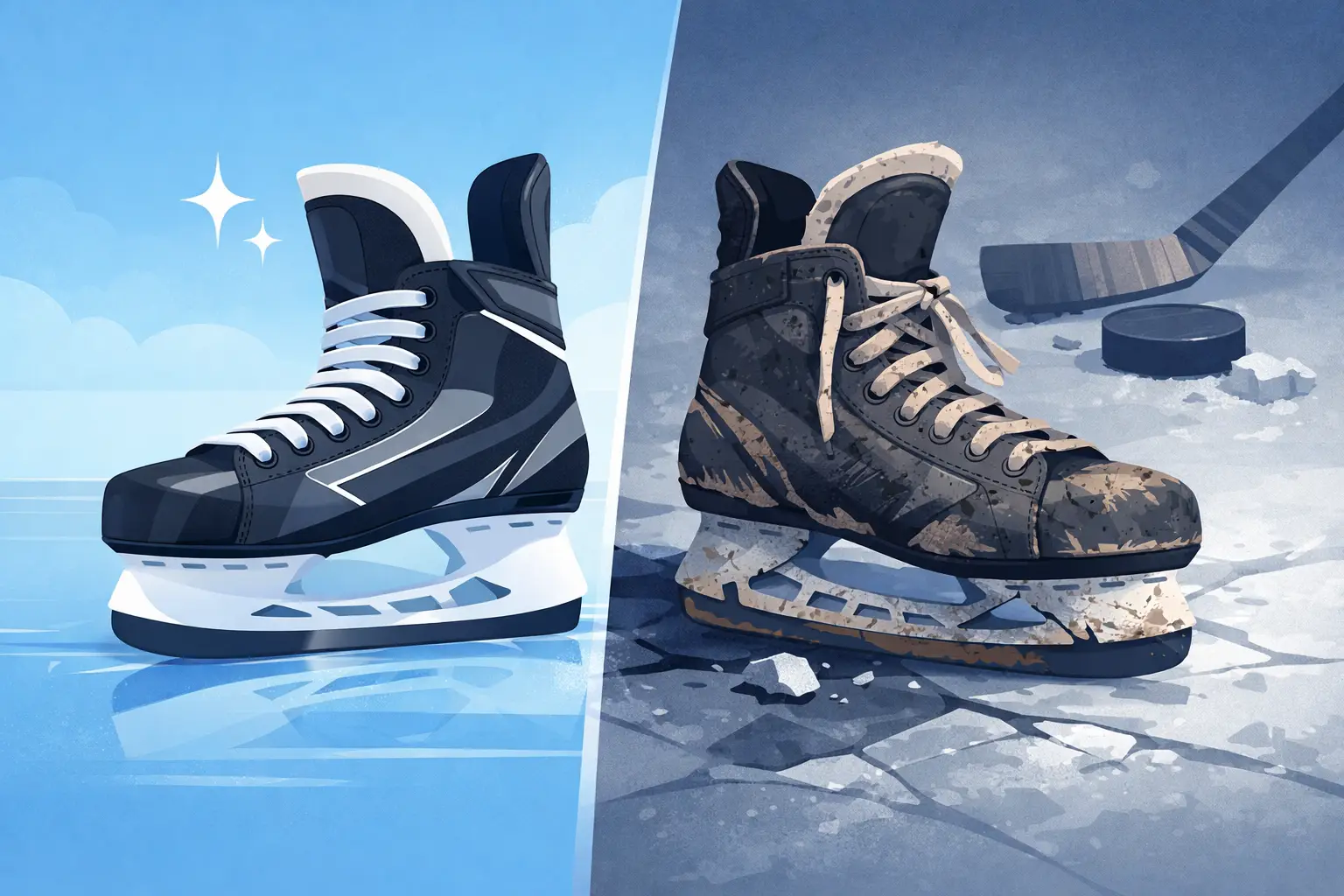
The boot tells the story faster than the graphics do. A skate can still look decent from a distance and be functionally done.
The boot has lost stiffness and support
This is one of the biggest indicators. When the quarter package softens, the skate stops giving the level of lateral support it was designed to provide. Players may notice their ankles working harder in turns, less response coming out of crossovers, or a generally unstable feel under load.
This matters most for higher-level players who rely on strong edge work and explosive movement, but even recreational skaters feel it eventually. If the skate folds more easily than it used to, or one boot feels noticeably softer than the other, replacement is often the right call.
The eyelets are pulling, cracking, or separating
Eyelet damage is more than cosmetic. If the facing is cracking, eyelets are popping loose, or the upper part of the boot no longer holds tension evenly, the skate will not lock the foot in place properly. In some cases, minor repairs can buy time. In others, especially when the surrounding material is compromised, the skate is nearing the end.
The outsole or holder shows serious wear
Look where the boot, outsole, and holder meet. Cracking, separation, or movement in this area can affect energy transfer and long-term durability. A damaged holder can sometimes be replaced, but if the rest of the skate is already breaking down, that repair may not make financial sense.
The steel is too worn to justify keeping the skate
Runners do not last forever. After repeated sharpenings, steel gets shorter and performance starts to drop. Less height means less bite angle and less room for future sharpenings. If the boot is still in excellent shape, replacing steel may be the smart move. If the boot is also soft, cracked, or misshapen, new steel alone will not solve the bigger issue.
The inside of the skate is breaking down
Check the liner, ankle padding, and heel pocket. Excessive wear inside the boot changes how the skate fits even if the shell looks intact. If the padding is packed out, the heel no longer stays secure, or rough internal wear is causing irritation, the skate may be past its useful life.
How long do hockey skates usually last?
There is no single timeline, because usage matters so much. A youth recreational player skating once a week may get multiple seasons, though growth often ends that cycle before wear does. A travel or rep player on the ice several times a week can wear through skates much faster. Junior, college, and high-level adult players put enough stress on the boot that breakdown may show up within a season or two, depending on the model and usage.
Higher-end skates generally use better materials and hold up longer under serious play, but they are not immortal. Mid-range and entry-level skates can be excellent choices for the right player, though they may soften sooner under heavy use. That is why the best replacement schedule is not a calendar date. It is a regular evaluation of fit and performance.
When repair makes sense and when it does not
Not every issue means it is time for a new pair. Steel replacement, rivet work, holder replacement, and minor eyelet repairs can extend the life of a skate that still fits well and maintains proper support. This is often the right approach when the boot remains structurally sound.
The line gets clearer when multiple issues show up at once. If the skate is too small, soft through the ankle, packed out internally, and down to tired steel, repair becomes a short-term patch on a long-term problem. At that point, replacement usually offers better value than continuing to fix a skate that can no longer perform as intended.
When should hockey skates be replaced for growing players?
Youth skates deserve closer attention because kids do not always describe fit problems clearly. Sometimes they simply skate less confidently, complain about tired feet, or avoid tightening their laces. A child may also curl their toes without realizing it, which makes a too-small skate easy to miss unless the fit is checked properly.
For families, the temptation is often to buy extra room for growth. The trade-off is control. Skates that are too large can hurt development just as much as skates that are too small hurt comfort. The better approach is a proper hockey fit, then reassess as the season changes. If a player has had a major growth spurt, moved into more competitive hockey, or started skating far more often, it is worth reevaluating sooner rather than later.
Performance changes that should not be ignored
Players often adapt to worn skates gradually, which can make replacement easy to postpone. They tighten laces harder, add insoles, change sharpening preferences, or assume the problem is their skating. Sometimes it is. But sometimes the skate is no longer giving back what the player puts into it.
If edge control feels less precise, acceleration feels muted, or recovery from aggressive turns feels unstable, the boot may be breaking down. Goalies can see similar issues in post integration, recovery movement, and general support through repeated up-and-down play. Equipment that no longer supports technique properly can also increase fatigue over the course of a game or practice.
What to check before you decide
Start with the basics. Confirm the skate still fits in length, width, and heel lock. Then inspect the exterior for soft spots, cracking, eyelet damage, holder movement, and outsole separation. Check the steel height and condition. Finally, pay attention to what the player is actually feeling on the ice.
That last part matters. A skate can pass a quick visual inspection and still be wrong for the player because it has lost its shape or support. Good equipment decisions come from combining what you see with what the player experiences.
At Majer Hockey, this is where expert fitting and pro shop guidance can make a real difference. A proper assessment can tell you whether your current skates need service, whether a component can be replaced, or whether it is time to move into a new pair that fits and performs the way it should.
The right moment to replace hockey skates is usually earlier than complete failure and later than the first cosmetic scuff. If the fit is off, the support is gone, or the skate is holding back performance, that is your answer. A well-fitted, structurally sound skate does more than feel better - it lets players skate the way they are supposed to.


 -
-